C-GBVK wrote:Bonjour
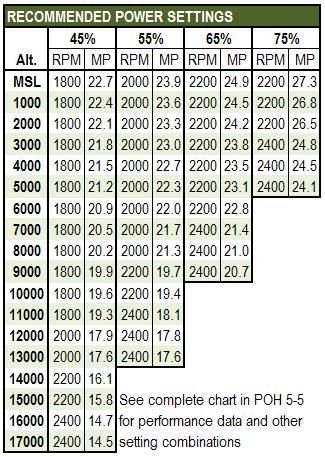
Pour bien des lycoming o-360 les RPM sont nettement plus haute que celle de ton manuel .
Idem pour le IO-360 A1A qui sont quasiment identique

J.y ai inclus mon point de référence
http://www.mooneypilots.com/mapalog/cruisepower.html
----------------------------------------------------------------------------
Last month, we made some suggestions for more efficient climb power settings. This month, let's look at some power setting ideas that might help you fly your airplane a little more efficiently and consistently in level cruise flight. These concepts come from my background as an engineering test pilot at Mooney and Cessna doing a variety of developmental and certification flight tests. This article is not meant to sound like I am a "know it all." The ideas presented are only for your consideration. You may be perfectly happy flying the way you are. But give some thought to the ideas presented in this article and give them a try on your next trip or two. Most of the suggestions and "rules" we hear about flying our airplanes are based on rumor and outdated technology. The ideas in this series of articles are based on sound engineering principles and lots of engineering flight test data. I think you'll find your airplane will give you more consistent performance if you try these cruise techniques.
Introduction
First of all, thanks for the positive comments regarding last month's article on more efficient climb power settings. From the feedback, it appears that a lot of you desire more operational information like this, so we will continue to bring it to you through these series of articles. In these articles. I am attempting to bring to you information based on sound engineering data and extensive engineering flight testing I did at Mooney several years ago during my career with the factory. With that said, this month let's take a look at some suggestions on engine power management and settings in level cruise for the most efficient way to cross the country in our Mooney.
I. Normally Aspirated (Non-Turbocharged) Power Settings for Cruise
So here we are, leveling off at our assigned (or desired) cruise altitude after climbing using the techniques described in last month's article. Our goal is to now transition as quickly and efficiently as possible into level cruise flight and to set the best power setting we can for extended cross country flying at our assigned or chosen altitude.
Accelerate First
As we level off in our normally aspirated Mooney, the first reaction we have is to do something right away. Don't. Just let the nose come down to level flight and allow the airplane to accelerate to cruise speed. Keep the climb power setting and keep the cowl flaps open for two minutes or so as the airspeed increases and stabilizes. Too many Mooney pilots like to begin reducing power immediately upon reaching cruise altitude. This really extends the time required for the airplane to accelerate and reach a stabilized cruise speed. So for the first two minutes or so after reaching cruise altitude--don't touch anything. Keep the power up. And leaving the cowl flaps open for a little bit eliminates the "hot spots" that developed under the cowling during the climb and helps the accessories (fuel pump, mags, vacuum pump) cool down quicker after they got hot in the climb. So, we've not touched anything for the last two minutes after reaching our desired cruise altitude. Now it's time to reset the engine for cruise. Here are my recommendations for setting cruise power In a normally aspirated Mooney.
Keep the Throttle Full Open
Remember, a normally aspirated engine operates most efficiently with the throttle full open. With the throttle in the full open position, the cylinders are getting the most volume and most even distribution of induction air possible. Engineers "tune" induction systems assuming a fully open throttle. Anytime you operate a normally aspirated engine at part throttle settings, you are adding a physical restriction in the induction airflow (a partially closed throttle valve). This restricts the amount of induction air flow and also makes it turbulent inside the induction system--not good for efficient engine operation.
In any normally aspirated (non-turbo) Mooney, the best cruise power setting is full throttle, 2500 RPM, Peak EGT +50 degrees rich, cowl flaps closed. Only the M20S Eagle whould be cruised at 2400 RPM.
So keep the throttle full open. The only time to back off the throttle in cruise in a normally aspirated engine would be 1) if you are flying below 3000 feet, where a full throttle would give some pretty high manifold pressures or 2) you're just out flying around to sightsee, where reduced power and slower speeds are called for. But for most cruise conditions where, you want to cross the ground quickly and in the most efficient manner, keep the throttle full open. And take whatever manifold pressure you get at full throttle. And for those airplanes with the ram air system, by all means open it for some added manifold pressure with the throttle full open. The increase in manifold pressure can be as much as 1" Hg, or about 10 horsepower. But only use the ram air after the throttle is full open and only use it when you are flying in clean air. The ram air system is nothing more than a bypass of the induction air filter, so anytime you open it you are venting unfiltered air directly into the engine. Good for power, but bad if you're flying in dust or heaven forbid a sandstorm.
For the M20K (231), try cruising at 31" MP, 2500 RPM, Peak TIT + 50 degrees rich, cowl flaps closed.
Prop RPM at 2500 (2400 in the Eagle Only)
Except for the new M205 Eagle, for the normally aspirated (non-turbo) Mooneys we fly,
the best RPM to cruise is 2500. Period. For the engine/prop combination in the Eagle, the best cruise RPM is 2400. You can talk about all kinds of reasons why 2400, 2300, or 2200 might he better, but from a pure technical standpoint, cruising at lower RPM settings makes no sense at all. By selecting cruise RPM lower than 2500 (2400 in the Eagle) you are simply giving away power and better performance for nothing in return. Think the engine will last longer at lower RPM settings? Forget it. TBO is set assuming maximum continuous power (that's max rated RPM). Think the engine will run cooler at lower RPM? Nope. As you increase the spread between MP (high) and RPM (low), internal engine operating pressures go up slightly, making the engine run just about as warm as it would at a higher RPM setting. And I have yet to fly a Mooney that is as smooth at 2200 or 2300 RPM as it is at 2500. So why do it? So try cruising at 2500 RPM. If you have an Eagle,2400. Everything else is giving away performance (our most valuable Mooney asset) for nothing in return.
Three Choices of Mixture Settings
I think you really have three choices of mixture settings with a normally aspirated engine. They are 1) 50 degrees rich of peak EGT (Exhaust Gas Temperature), 2) peak EGT, 3) 50 degrees lean of peak EGT. My choice? 50 degrees rich of peak EGT. All the time. It's the best combination, in my opinion, of best power mixture (100 degrees rich of peak EGT) and best economy mixture (peak EGT). Some pilots like to fly at peak EGT --that's okay, you save a little gas but loose some performance. Lean of peak EGT is okay too, but only if you're flying a fuel-injected, normally aspirated engine and have a good set of balanced fuel injectors installed. Operating lean of peak EGT is impossible if your fuel injectors aren't balanced to "squirt"equal amounts of fuel into each cylinder -- one or two cylinders are going to get too lean before the others, resulting in a very rough running engine.
For the M20K (252), 28" MP, 2500 RPM, Peak TIT +50 degrees rich, cowl flaps closed works well at all altitudes.
For engines with a carburetor, forget lean of peak EGT operations. Carburetors are very poor fuel distributors. I haven't seen many carbureted engines that could be operated lean of peak EGT with any level of smoothness. The engine feels like it's coming out of the cowling. A final word on leaning -- take the time to find a true peak EGT value when you are setting the mixture for cruise. Most pilots don't have the patience to find a good peak EGT reference value. There is considerable lag between the EGT gage indications and the movement of the mixture control--it simply takes a few seconds for the change in the exhaust gas temperature to register on the gage. So, be patient when establishing peak EGT. Lean a little, wait for the EGT to register, lean a little more, wait, etc. Finding a true and accurate peak EGT reference point is critical to precise engine operation and proper cruise mixture setting.
Cowl Flaps Closed
In all but Ihe most extreme heat, level cruise flight in a normally aspirated Mooney should always be done with the cowl flaps full closed. Normally aspirated Mooneys cool well in level cruise. So keep those cowl flaps tucked up tight in level flight. If you're having to trail open the cowl flaps in you're normally aspirated Mooney to keep that engine cool in cruise, something is wrong with your engine.
-------------------------------------------------------------------------------------
Martin
P.S.
Par contre je ne mettrais pas ma vie en jeux au sujet de ce qui est ecrit là, pour la simple raison que j'ai pas vue crucifie de Mooney passer le cap des 1000-1300hrs sans avoir un top...